In active litigation practice, the quality of source files is rarely pristine. Advocates in India frequently deal with poorly scanned PDFs, blurred photocopies, and mobile photos of handwritten trial court records, First Information Reports (FIRs), charge sheets, and sale deeds.
When these documents must be translated or digitized for court submissions, traditional optical character recognition (OCR) and translation engines fall short. They either fail to read the text entirely due to blurriness, or they scramble the document's structure, collapsing tables, letterheads, and key structural alignments into a single block of unreadable text.
Modern generative AI has changed this. By combining Devanagari-trained OCR with layout-aware translation models, legal teams can now translate low-quality documents while fully preserving their original structure and table formatting.
1. The Challenge of Blurry and Low-Resolution Scans
For litigation attorneys, the path of a document is often chaotic:
- An FIR is hand-written by a police officer in regional script, photocopied multiple times, and then scanned on a basic scanner.
- A witness statement is photographed using a mobile phone in a dimly lit courtroom corridor.
- A property sale deed contains multi-column tables detailing boundary metrics, scanned at low resolution decades ago.
Traditional OCR systems (such as standard Tesseract or legacy document editors) rely on high-contrast, clean print text. When faced with Devanagari script, handwriting, or blurriness, they introduce severe character errors. More importantly, they lack "spatial awareness." They process text from left to right, top to bottom, stripping away tabulations, columns, and structural alignments.
2. Why Layout and Table Preservation Matters in Court
In legal translation, formatting is not just about aesthetics—it is a matter of procedural compliance.
Under High Court and District Court rules across India, translated documents must correspond directly to the original filings. When a judge or opposing counsel reviews a translated FIR or contract, they perform a line-by-line comparison:
- Correspondence: If the original document has a recipient block, a subject line, and numbered paragraphs, the translation must mirror that layout.
- Table Integrity: Financial statements, boundary tables, and schedule lists must remain in tabular format. If columns are collapsed into inline text, matching values against the original is nearly impossible, causing unnecessary delays in court hearings.
- Contextual Readability: Formal elements like signatures, stamp marks, and dates must remain in their original positions to establish authenticity.
3. Junior Lawyer's Solution: Structure-Aware Legal Translation
To address these challenges, Junior Lawyer utilizes a specialized, legal-grade OCR and translation pipeline designed specifically for the unique realities of Indian trial and appellate courts.
Devanagari Handwriting OCR
Our models are specifically trained on thousands of variations of Devanagari script, including cursive handwriting, poor print qualities, and low-contrast scanned pages. It reconstructs words by looking at contextual legal vocabulary, resolving blurry characters that standard engines miss.
Spatial Layout Analysis
Rather than flattening the document into a single stream of characters, the engine performs document layout analysis. It identifies tables, grids, paragraph blocks, header sections, and signature regions, maintaining their spatial positions.
Context-Preserving Translation
During translation, the AI maintains the tabular structure. It translates the contents of each cell, header, and paragraph independently while keeping the visual grid intact, outputting a document that mirrors the original file.
4. Real-World Case Study: Translating a Blurry Devanagari Document
To see this technology in action, consider the following real-world example from the Junior Lawyer workspace:
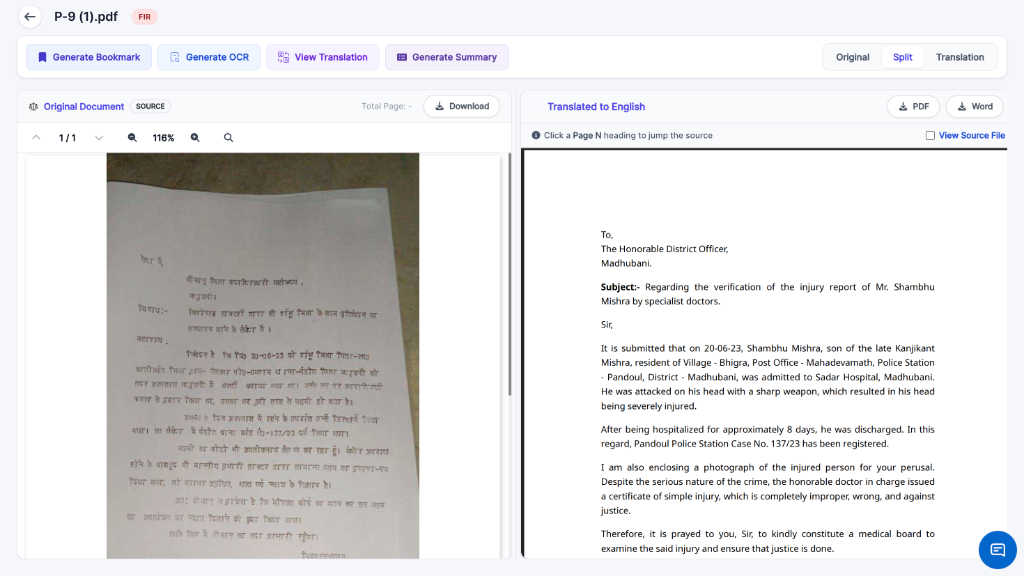
Split view showing the original blurred Hindi handwritten document on the left and its perfectly structured, English-translated equivalent on the right
In this case study:
- The Source File (Left): The document is a photo of a hand-written letter in Devanagari script (an injury report verification request sent to the District Officer in Madhubani). The text is slightly skewed, shot under yellow lighting, and has soft focus/blurriness.
- The Translation Output (Right):
- Header Structure: The recipient block ("To, The Honorable District Officer, Madhubani.") is neatly formatted and aligned.
- Subject Line: The bolded subject line ("Subject:- Regarding the verification of the injury report...") is extracted and translated without losing its emphasis.
- Body Paragraphs: The AI translates the narrative details (such as dates like "20-06-23", proper names like "Shambhu Mishra", and regional locations like "Village - Bhigra, Post Office - Mahadevamath") with perfect grammar and contextual flow.
- Clean Presentation: The output is highly structured, removing the physical skew and lighting artifacts of the original photo, making it immediately ready for formal drafting or court reference.
5. Strategic Benefits for Legal Practitioners
By utilizing structure-aware translation, law firms and independent advocates gain significant operational efficiencies:
- Zero Manual Re-Alignment: Lawyers no longer have to spend hours copy-pasting text into MS Word tables or manually formatting columns.
- Accurate Citations: Proper names, section numbers, and monetary figures are extracted without typographical mix-ups.
- Downloadable Formats: Documents can be downloaded directly as editable Word files or clean PDFs, ready to be integrated into formal petitions.
- Dual-Pane Verification: The side-by-side split screen view allows juniors and seniors to quickly verify translation accuracy against the original source file.
Conclusion
Litigation relies on documents, and documents in India are often messy. Using general-purpose translation tools for legal work leads to errors and formatted layouts being lost. With Junior Lawyer's Devanagari OCR and structure-aware translation, advocates can convert low-quality scans and handwritten filings into perfectly formatted, court-ready English documents in seconds.